
Unique collection of Paul Auster’s books displayed in Copenhagen
Three hundred books from American author Paul Auster’s private library can now be explored at the library at The University of Copenhagen. It is the only place in the world where part of the author’s private book collection is on display.
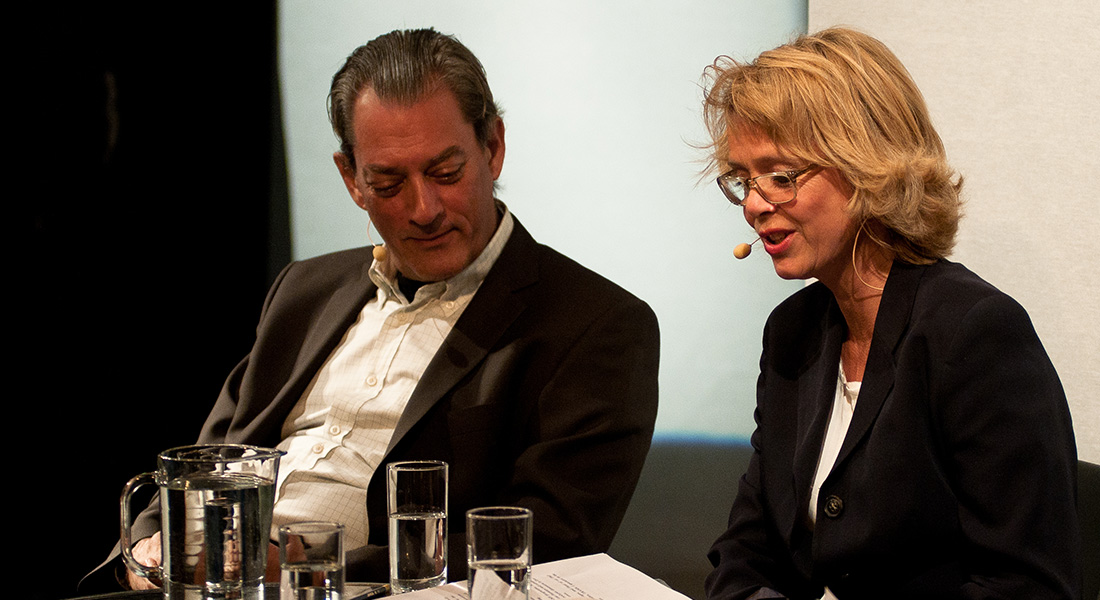
Many of them have dog-ears, underlinings and tea stains. Small traces and tell-tale signs that they have passed through the hands of an avid reader. And now researchers, students and Auster fans can leaf through the very books that inspired Paul Auster to write works such as The New York Trilogy, The Music of Chance and 4 3 2 1.
Three hundred books from Paul Auster’s private library in Brooklyn have recently made the journey from New York to Copenhagen, where they are now available for study at the UCPH library in downtown Copenhagen.
The collection, named The Paul Auster Collection (link), is displayed in the old, historic library. The room is inspired by Auster’s office and writing room in Brooklyn, complete with a desk, a vintage Olivetti typewriter and, of course, the books.
“The books were selected to provide a representative cross-section of Paul Auster’s library, which contained several thousand volumes. Auster is known for his intertextuality and his references to classical literature, philosophy, film and much more,” explains Inge Birgitte Siegumfeldt, a literary scholar at the University of Copenhagen and director of The Paul Auster Research Library at the university, an international hub for Auster research. She also co-authored the book of conversations A Life in Words (2016) with Paul Auster.
Paul Auster himself described his relationship with books like this: “I have all these books inside my head, and all these writers speaking to me. I feel as though I’m out in the world, but in fact I’m sitting alone at home at my desk.” This experience has been an important source of inspiration for the way the collection is presented:
“The exhibition is an attempt to capture precisely that: the desk and the room filled with books that Paul Auster read and was inspired by. We have also placed quotations around the room in which he describes what it is like to be alone while simultaneously having a mind full of other people,” says Inge Birgitte Siegumfeldt.
From Beckett and Poe to baseball and Laurel and Hardy
What the 300 selected books have in common is that they are either mentioned in Auster’s novels or written by authors who played a role in his work. And they have a remarkably broad span:
"People who know Auster’s work will know that he had a wide range of interests. Intellectually, he was fascinated by many subjects, including philosophy and language, so the collection contains works by some of the great thinkers. But he was also interested in baseball, Laurel and Hardy, film theory, Jewish studies and all sorts of things in between," says Siegumfeldt and adds:
"Samuel Beckett was one of his favourite writers, and probably the writer who influenced him most, so there are many books by Beckett in the collection. The same is true of modern French poetry. But the collection also includes many of the great American writers, such as Edgar Allan Poe, Nathaniel Hawthorne and Herman Melville, all of whom inspired Auster in different ways."
For researchers and fans alike
The books were donated to the Royal Danish Library by Paul Auster and his wife, author Siri Hustvedt. Among those who will be able to make use of the collection are the researchers who visit The Paul Auster Research Library at the University of Copenhagen each year. But the collection will also be open to the public, allowing Auster’s many readers to see for themselves what the author was reading while creating his own stories.
According to Inge Birgitte Siegumfeldt, the fact that the books have ended up in Copenhagen rather than, for example, New York or Paris has to do with her long-standing collaboration with Paul Auster.
“Auster and I worked for almost five years on A Life in Words, which has been published in seven languages, and our research hub attracts some of the world’s leading Auster scholars every year. We have a digital database containing most of Auster’s book manuscripts in four or five different languages, and it is used by many students and researchers working in fields such as translation theory and cultural studies.”
But you do not have to be a researcher or an Auster expert to get something out of the exhibition, Siegumfeldt says:
“The collection reflects Auster’s body of work, and it tells a story about intertextuality, cultural diplomacy and the way literature travels across national borders. It also reveals something about relationships, values and ways of viewing the world and other people and, not least, just how deeply Paul Auster himself was influenced by other people, books and ideas.”
The Paul Auster Collection officially opens at the University Library in Fiolstræde 5 October.
Paul Auster’s Haunted Books
To mark the opening, Siri Hustvedt and Professor Emeritus Norman Finkelstein will take part in a conversation on 5 October at 7:30 pm about ghosts, doubles and the many forms of haunting in Paul Auster’s writing.
Tickets are available on Billetto.
Contact
Associate Professor Inge Birgitte Siegumfeldt
Department of English, Germanic and Romance Studies
Email: siegum@hum.ku.dk
Phone: + 45 23 25 16 44
Communications Consultant Pernille Munch Toldam
UCPH Communication
Email: pmunch@adm.ku.dk
Phone: + 45 29 92 41 69