
New study rekindles contested question: Earth and Mars had different origins
Surprising discovery suggests that Mars and Earth formed through different processes. The finding could help scientists understand whether planets in other galaxies are habitable.
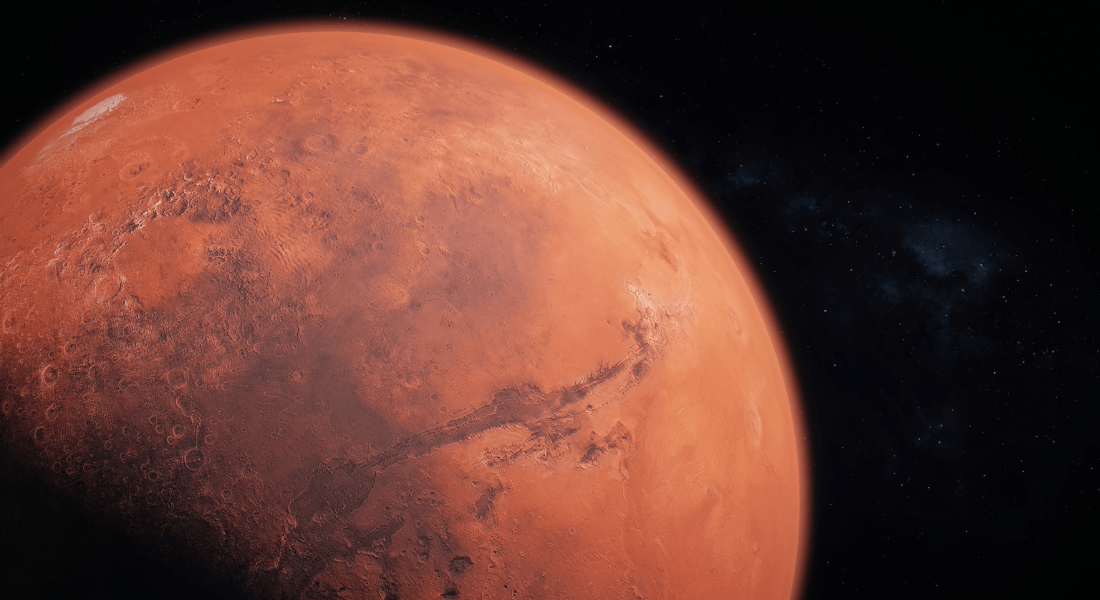
Four and a half billion years ago, Earth and Mars were born in the rotating cloud of gas and dust that would eventually become our Solar System.
Yet exactly how the planets formed remains one of the most disputed questions in planetary science.
Now, researchers at the University of Copenhagen are adding new evidence to the debate. Using a novel approach, they have reconstructed the earliest stages of the planets’ formation by analysing their chemical composition.
And the results surprised them.
“The most surprising result was that Earth and Mars appear to have formed in different ways. You might have expected that two planets formed side by side in the same solar system would share a more similar formation history,” says Professor Anders Johansen, who studies planet formation at the Globe Institute, University of Copenhagen. He co-led the new study with Assistant Professor Haiyang Wang.
The birth of Mars and Earth
Today, researchers broadly agree that planets are formed primarily in one of two ways, or through a hybrid of both processes:
Planets either emerge when giant space rocks, known as planetesimals, collide, or when these large rocks accumulate smaller particles, a process known as pebble accretion.
Planetary scientists have not settled on which of the two processes or a combination thereof would best explain how rocky planets such as Earth and Mars formed.
The researchers behind the new study believe that their findings support the so-called hybrid model. However, the study takes one step further and offers a more explicit explanation of how Earth and Mars formed 4.5 billion years ago.
“At least 75 percent of Earth’s mass appears to originate from two young planets, known as protoplanets, that grew large by accreting pebbles, while planetesimals contributed up to 25 percent. In contrast, roughly three-quarters of Mars’ mass appears to come from planetesimals, with the remaining quarter originating from pebble accretion,” says Haiyang Wang.
Planetary chemistry reveals the past
To understand how planets formed billions of years ago, scientists must rely on traces that still exist today.
In the new study, the researchers closely examined specific elements in the outer layers of the planets: the crust and mantle. They focused particularly on so-called volatile elements, which evaporate relatively easily at high temperatures, such as sodium, zinc, and potassium.
According to the researchers, the presence, or absence, of these elements acts as a chemical fingerprint that reveals the processes planets underwent during their formation. Using advanced computer models, they can then determine which formation scenarios are the most likely explanations for the origins of Earth and Mars.
“It is a major detective job to figure out what happened back then when most of the evidence disappeared long ago. But even after 4.5 billion years, the compositions of Earth’s and Mars’ mantles remain the same. You can think of them as an imprint of the formation process,” says Anders Johansen.
About the study
The study investigates how Earth and Mars formed 4.5 billion years ago by analysing specific elements in the crust and mantle of the two planets. The researchers used advanced statistical computer modeling to calculate the most likely formation processes.
According to the study, Earth and Mars formed in different ways: Mars formed primarily through collisions between massive rocks known as planetesimals. Earth, by contrast, began largely as two protoplanets that grew by gathering pebble-sized particles in a process called pebble accretion.
The findings support the so-called hybrid model, in which both mechanisms contributed to planetary formation.
The researchers stress that the results are based on statistical modeling and a number of assumptions regarding the composition of the building blocks present in the young Solar System that later would become the two planets. These include the assumption that the planetesimal building blocks of Earth and Mars were chemically similar to the asteroid Vesta, and that volatile elements are lost more efficiently during pebble accretion than during giant impacts.
The researchers used computer simulations to demonstrate that volatile elements are lost from pebbles as they travel toward a planet’s surface.
The study was published in the scientific journal Nature Astronomy.
The researchers emphasize that their computer models contain uncertainties. For example, the exact chemical composition of the original building blocks in our Solar System that eventually became Earth and Mars remains unknown.
As a result, the models rely on several assumptions. However, even when adjusting for those assumptions, the main conclusion remains unchanged.
“The exact percentages may vary somewhat, but our analyses consistently indicate that Earth and Mars formed in two different ways. Our method provides a more precise and direct way of understanding planet formation than the more widely used isotope-based approach, which can often be interpreted in multiple ways,” says Haiyang Wang.
Could help the search for habitable planets
The researchers also see applications beyond our own Solar System.
Several future space missions aim to discover and study Earth-like planets in other galaxies.
Understanding the chemical compositions of such planets is important for assessing whether they are potentially habitable, the researchers point out.
“If we understand how planets lose volatile elements during their formation, we can also become better at predicting how much water and other life-supporting substances they ultimately retain,” says Anders Johansen.
Contact
Professor Anders Johansen
Globe Institute
Email: Anders.Johansen@sund.ku.dk
Phone: +45 25 68 95 01
Assistant Professor Haiyang Wang
Globe Institute
Email: haiyang.wang@sund.ku.dk
Phone: +45 31 88 72 57
Communications Consultant William Brøns Petersen
UCPH Communication
Email: william.petersen@adm.ku.dk
Phone: +45 93 56 55 80